
The Future of Research Is Not a Better Chatbot
Why research AI should preserve the chain between claims, evidence, and human judgment—not simply generate more confident answers.
An AI can give you an answer in seconds.
It can still take hours to decide whether that answer deserves to be believed.
That is the contradiction at the center of modern research. Information has become easier to generate, summarize, and reshape, but not necessarily easier to trust.
The faster the answer arrives, the more important the questions behind it become:
- Which source supports this claim?
- What did that source actually say?
- What context disappeared in the summary?
- Can I defend this sentence when someone asks where it came from?
These are not chores around the research. They are the research.
The future of research is not a chatbot that sounds more certain. It is a system that keeps the path from question to claim to evidence intact.
Research breaks when context disappears
A serious question rarely ends with one answer. It opens a chain of work.
You find sources, inspect methods, compare arguments, capture evidence, revise your view, and write something another person can challenge.
The final sentence may be short. The reasoning behind it may span twenty papers, several false starts, dozens of notes, and a week of changing your mind.
AI has made the sentence cheap. The chain of reasoning is more valuable than ever.
Yet that chain is often scattered before the thinking begins. The paper is in one tab, notes in another, citations in a separate manager, and a useful passage somewhere in browser history.
Each tool may work perfectly on its own. The failure happens between them.
At every handoff, context leaks away. Researchers reread papers, hunt for known passages, and spend attention rebuilding the trail instead of advancing the thought.
This is not a personal productivity problem. It is an infrastructure problem.
The useful unit is a traceable thought
Most AI products treat the answer as the finished object. Research needs a different unit: a thought that can be traced.
A useful claim remains connected to the passage that supports it. A note remembers the paper it came from. A draft keeps the citations that make it defensible.
That continuity changes how AI can help.
Instead of replacing the researcher with a confident response, the system can preserve the material needed to inspect, challenge, and improve the response.
The question is no longer only, What did the AI say?
It becomes, What can I see when I need to decide whether it is right?
That is the idea behind Research Intelligence: an environment for collecting, interrogating, connecting, and communicating knowledge while keeping the source trail close.
Oystack is being built around that idea.
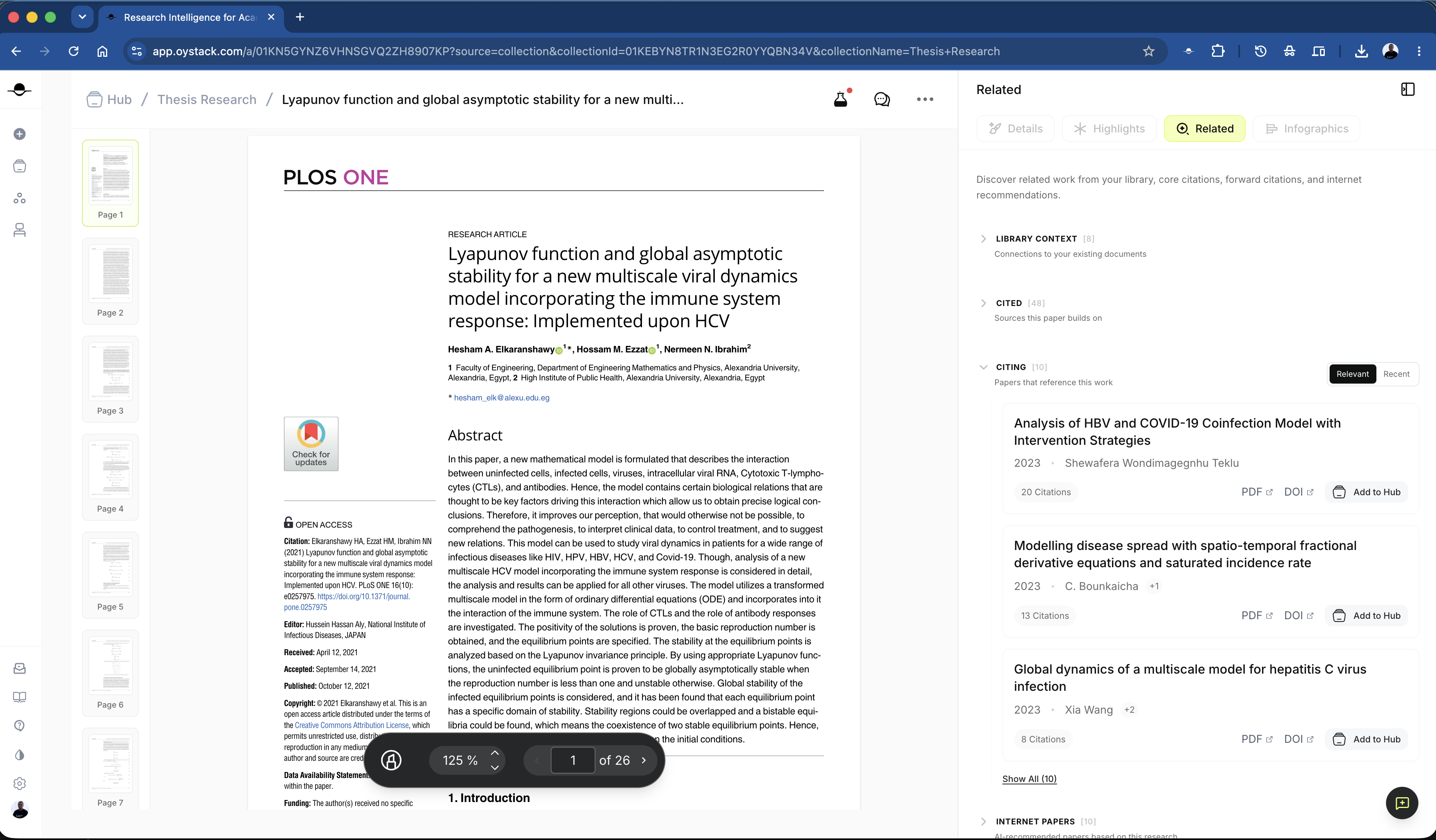
Open a paper and the paper remains the center of the work. Questions stay grounded in its contents. References, forward citations, related work, and library context remain available for the next move.
The point is not to add more AI around a PDF. It is to stop the source from disappearing the moment an answer appears.
Trust must be built into the workflow
Many AI products treat trust as a warning beneath the input box: AI can make mistakes. Check important information.
The warning is true. It does not make verification practical.
Trust is not a label. It is a product decision.
Researchers need visible sources, attached citations, and a short path from a generated claim back to its evidence.
They need to see where sources disagree. They need uncertainty to remain visible. They need proposed work to stay reviewable before it becomes their own.
This does not mean every decision can be automated safely.
AI can surface material, trace citations, compare arguments, organize evidence, and reveal connections that deserve attention.
The researcher still decides what counts as evidence, whether a method supports a conclusion, why sources conflict, and what is responsible to claim.
A capable research system should strengthen that judgment, not hide the need for it.
A better way to research
Research is not a prompt. It is an arc.
Find. Read. Compare. Question. Synthesize. Write. Cite. Review. Reconsider.
Then it loops.
A new source changes the question. A contradiction reshapes the argument. A limitation sends you back into the literature. A paragraph reveals what you still do not understand.
Tools built around isolated prompts lose that continuity. The researcher has to reconstruct the body of work each time.
Oystack takes the opposite approach: the collection remains available, the paper remains readable, and the relationships between questions, evidence, and writing remain part of the workspace.
The next generation of research tools will not win by producing the longest answer or imitating certainty most convincingly.
They will win by helping people build knowledge that survives scrutiny.
Claims with sources. Notes with memory. Questions with context. AI work that a human can inspect before adopting.
Not a better chatbot. A better way to research.

